Federal:
— EPA Renovation Firm Certification (Lead-Based Paint Abatements and/or Renovation, Repair and Painting Activities), cert #NAT-F334099-1, 30 April 2026 (renew 2031)
— EPA Renovation Repair Painting (RRP) Initial Course, Certified Renovator, cert #R-I-T210065-26-01084, 3 Apr 2026 (renew 2031)
— ANSI/OSHA-Compliant Laser Safety Officer Course, cert #662165, 16 Mar 2026 (renew 2029)
Company training includes the following regulations:
— 21 CFR parts 1040.10 and 1040.11, Federal Laser Product Performance Standard
— 40 CFR, Chapter I, Subchapter R, Part 745, Lead-Based Paint Poisoning Prevention in Certain Residential Structures
— EPA Pamphlet EPA-740-K-11-001, Steps to Lead Safe Renovation, Repair and Painting, Jan 2025
— EPA Pamphlet, The Lead-Safe Guide to Renovate Right, Sep 2011 (also provided to each client)
— OSHA Technical Manual Section III, Chapter 6, Laser Hazards
— ISO 11553-2, Safety of Machinery — Laser Processing Machines, Part 2: Safety Requirements for Hand-Held Laser Processing Devices
— ANSI Z136.6, Safe Use of Lasers Outdoors
— ANSI Z136.7, Standard for Testing and Labeling of Laser Protective Equipment
— ANSI Z136.8, Safe Use of Lasers in Research, Development, or Testing
Washington DC:
— DC Dept of Energy & Environment (DOEE) Business Entity Certification for firms conducting renovation activities: cert #BE DC26-5639, 3 June 2026 (renew 2031)
— DC DOEE Training: Satisfied by EPA RRP course, 3 Apr 2026 (renew 2031)
— DC DOEE Requirements for Lead-Based Paint Certification and Permitting: As required per job
Company training includes the following regulations:
— DC Law 17-381, Lead-Hazard Prevention and Elimination Act of 2008
— DC Municipal Regulations, Chapters 20-33, Regulation of Lead-Based Paint Activities, Title: 20 Environment
Virginia:
— Department of Professional and Occupational Regulation (DPOR): Reviewed 19 May 2026
Maryland:
— Maryland Home Improvement Commission (MHIC): Pending
-
921 H St NE #180
Washington DC 20002
-
(202) 599-8299
-
CERTIFICATIONS & TRAINING
LICENSES
Washington DC:
— Basic Business License (BBL), #400326807462, 26 May 2026
— Limited Liability Company (LLC), #US-DC-LL052600464, 7 May 2026 - 6 May 2028
— Clean Hands Certificate, notice #L0016686532, case ID #18980865, complied with DC Code 47-2862, 22 May 2026
Virginia:
— Foreign LLC license, #BE22357448-23484161, filing #26060910111534, work order #202606097461887, 9 June 2026
Maryland:
— Foreign LLC license: Pending
— MHIC contractor license: Pending
INSURANCE
Washington DC:
— Commercial General Liability Insurance: Travelers Business Owner's Policy (BOP) via Bridge First Financial: Policy BIP-C9145345-26-42, effective thru 25 April 2027
— Certificate of Insurance (COI) available upon request
Virginia:
— Same as above
— Certificate of Insurance (COI) available upon request
Maryland:
— Same as above
— Certificate of Insurance (COI) available upon request
EQUIPMENT
Personal Protective Equipment (PPE):
For Laser Work:
1. Laser safety goggles/glasses
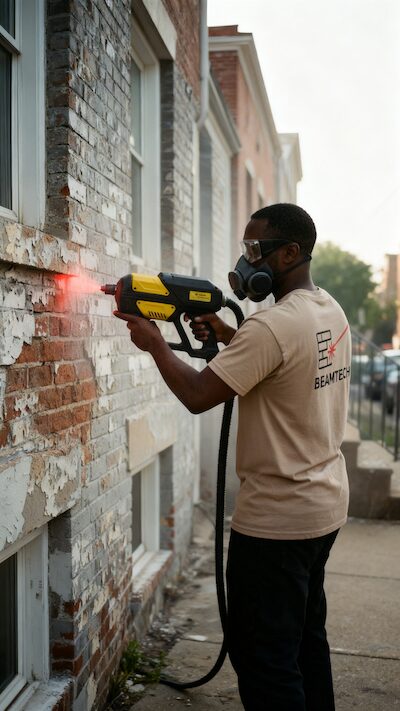
2. Respirator (NIOSH-approved with P100/HEPA filters or combination HEPA + organic vapor cartridges)
3. Protective clothing
4. Heat-resistant or leather gloves
5. Closed-toe shoes
6. Head covering
7. Face shield
For Lead-Based Paint Work:
1. Respirator (NIOSH-approved half-face or full-face with P100/HEPA filters: N100, R100, or P100 rated)
2. Full-body disposable coveralls
3. Gloves (Disposable nitrile, latex, or chemical-resistant)
4. Safety goggles or face shield
5. Disposable shoe covers/booties
6. Disposable head covering (painter’s hat or hood)
Worksite Safety:
Provide EPA "Renovate Right" pamphlet to clients before work starts; client acknowledgment
For Laser Work:
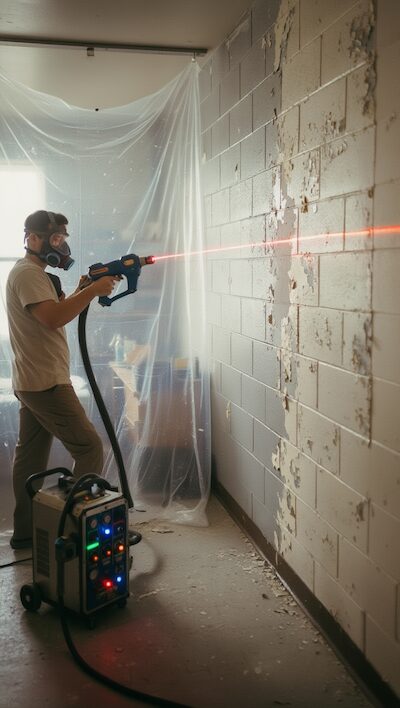
[Laser cleaning minimizes visible dust, but fumes require capture via laser's fume extraction system (if equipped) or supplemental local exhaust ventilation (LEV) with HEPA filtration]
1. Warning signs: Post at all entry points to controlled area
2. Laser Safety Officer (LSO) on site (our laser operators are also LSOs) for assessment, procedures, training, compliance
3. Establish Nominal Hazard Zone (NHZ): area where exposure could exceed safe limits (often several meters depending on power density, wavelength, reflections from surfaces like metal/brick)
4. Access control: Lockout/tagout laser when not in use; interlocks or remote shut-off if the laser supports it
5. Establish Nominal Hazard Zone (NHZ): area where exposure could exceed safe limits (often several meters depending on power density, wavelength, reflections from surfaces like metal/brick)
6. Barriers and sheeting: Combine with lead containment. Use opaque laser safety curtains, barriers, or screens rated for laser wavelength to block stray/scattered beams (reflective surfaces like metal can create hazards)
7. Erect physical barriers (e.g., fencing, cones, tape) around NHZ to prevent unauthorized entry. Exterior work: integrate with plastic sheeting for dual lead/laser containment
8. Fume extraction to capture Laser Generated Airborne Contaminants (LGAC) including lead vapors; vents safely away from people
9. Fire prevention: Extinguishers rated for electrical/laser fires
10. Test air quality if feasible
For Lead-Based Paint Work:
1. Warning signs at all approaches (exterior work: signs visible from 20 ft)
2. Containment/sheeting: heavy-duty (e.g., 6-mil) plastic sheeting to fully enclose work area and protect ground, nearby surfaces, windows, doors, and landscaping
3. Exterior work: vertical barriers (plastic sheeting on frames or scaffolding) to contain debris; secure sheeting to prevent escape of particles. Protect or remove movable items; cover fixed items
4. Access control: Restrict area with barriers (e.g., caution tape, fencing, or sheeting) to keep occupants, pets, and passersby out. Use entryway controls if needed
5. Cleanup: EPA protocols for wet cleaning methods, HEPA vacuuming, disposable wipes, and cleaning verification. No dry sweeping or standard vacuums
6. Waste disposal: Treat lead-contaminated debris/sheeting as hazardous waste per local/DC rules. Sealed containers and proper disposal


